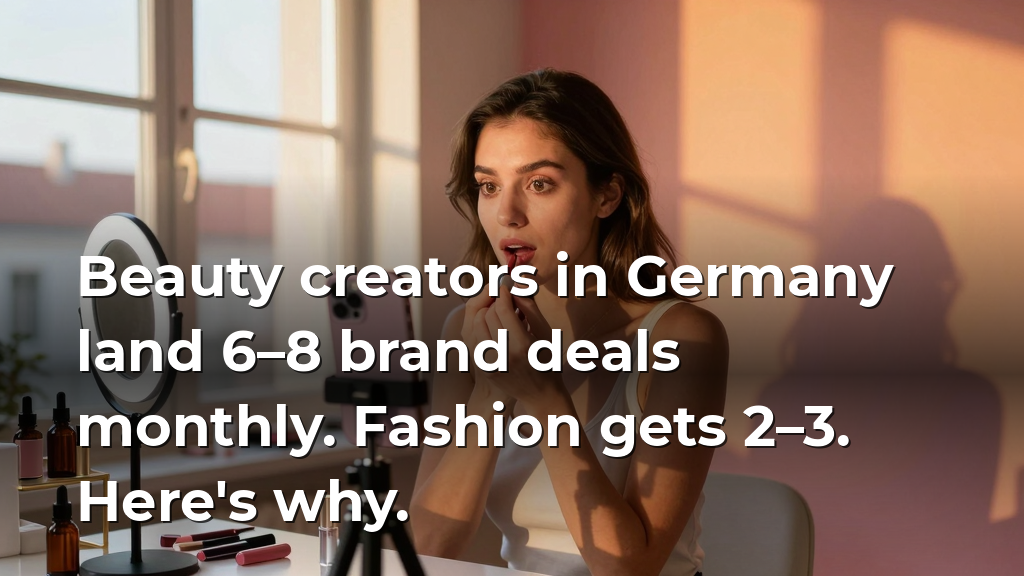
Beauty creators in Germany land 6–8 brand deals monthly. Fashion gets 2–3. Here's why.
17 July 2026
·7 min read
Beauty creators with 50k followers land 6–8 paid collaborations monthly—fashion gets 2–3
That's not a typo. According to a recent analysis by Virtual Faces, beauty accounts in Germany with 50,000 followers secure six to eight paid brand deals every single month. Fashion accounts of the same size? Two to three. The gap is wider than most sales teams realise, and it's not random. It's structural.
The German cosmetics market sits at roughly €13 billion in annual end-consumer revenue (2024). That's a lot of lipstick, serum, and shampoo. But the real driver isn't just market size—it's product velocity. The average beauty brand launches eight to twenty new products per year. Fashion? Two main collections. More products means more campaigns, more seeding, more paid collaborations. Simple math.
If you're an agency or consultancy trying to place creator deals for clients, or a sales team building outreach lists, this changes your targeting calculus. Beauty isn't just a vertical—it's a volume play.
Why beauty's brand-deal density crushes fashion in the creator economy
Product launch cadence is the hidden multiplier
Fashion operates on a seasonal rhythm: spring/summer, autumn/winter, maybe a capsule collection. Beauty operates on a constant drip. A single brand like L'Oréal or Maybelline can drop a new foundation shade range, a mascara reformulation, and a limited-edition lip collection in the same quarter. Each launch needs creators. Each creator needs a brief, a product, a post, a tracking link.
That's why brands like dm, Rossmann, Sephora, L'Oréal, Cosrx, Catrice, The Ordinary, Paula's Choice, La Roche-Posay, Gliss Kur (Henkel), Garnier, Bouclème, Weleda, and i+m Naturkosmetik are all actively running creator programmes in Germany right now. They're not waiting for fashion week. They're launching every month.
For sales teams using platforms like MiraReach to automate prospect discovery and outreach, this means one thing: beauty buyers have a higher probability of needing your services right now, not next season.
Micro-influencers outperform mega-accounts by a factor of 3–5x
Here's where the data gets interesting for anyone building creator lists. Micro-influencers in the beauty niche—accounts with 10,000 to 50,000 followers—achieve engagement rates of 4–6%. Mega-accounts with hundreds of thousands of followers? 1.2%. That's according to the German Influencer Marketing Association.
Brands have noticed. They're booking ten micro-influencers for the price of one mega-star. Why? Because ten posts from ten trusted voices outperform one post from a celebrity whose audience stopped caring about their content two years ago. The math works for reach, but it works even better for conversion.
If you're scoring inboxes or prioritising outreach targets, micro-influencers in beauty should be near the top of your list. They're cheaper, more responsive, and more likely to say yes to a long-term retainer.
Six beauty sub-niches with different brand-deal economics
Not all beauty content is created equal. Virtual Faces identified six distinct sub-niches in the German beauty creator space, and each has its own deal dynamics.
Makeup Tutorials & GRWM (Get Ready With Me)
This is the volume leader. High posting frequency, high brand interest, relatively low barrier to entry. Recommended as a starter strategy for new creators. Brands like Catrice and Maybelline run regular campaigns here.
Skincare Routines
This sub-niche has the highest average Brand-Deal CPM in beauty. Why? Skincare requires trust. A viewer won't buy a €50 serum from someone they don't believe actually uses it. Brands like La Roche-Posay, The Ordinary, and Paula's Choice pay a premium for authentic skincare content because the conversion rates justify it.
Hair Styling
Gliss Kur, Garnier, and Bouclème are active here. Lower deal volume than makeup, but longer content shelf life. A hair tutorial can generate traffic for months.
Nails
Niche but loyal. Brands are fewer, but engagement is high. Good for specialists.
Editorial/Avant-Garde
High-glam, high-production-value content. Fewer deals, but higher per-deal fees. Think editorial campaigns for Sephora or luxury launches.
Sustainable/Clean Beauty
Fastest-growing sub-niche in Germany. Brands like Weleda and i+m Naturkosmetik are leading the charge. German consumers care deeply about sustainability, and this sub-niche is seeing the highest growth in both creator supply and brand demand.
For sales teams, the takeaway is clear: if you're targeting beauty, don't treat it as one category. Skincare routines command higher CPMs. Sustainable beauty is growing fastest. Makeup tutorials offer volume. Tailor your outreach accordingly.
Three aesthetic profiles that win brand deals in German beauty
Virtual Faces also identified three established aesthetic profiles that brands consistently prefer. If you're advising creators or building a portfolio, these matter.
Warm Cottagecore (Clean/Natural Beauty)
Soft lighting, natural textures, minimal makeup. Works well for Weleda, i+m, and clean beauty brands. The aesthetic signals authenticity and sustainability.
Cool Clinical (Skincare)
Clean backgrounds, white lighting, dermatologist-adjacent vibes. This is the aesthetic for La Roche-Posay, The Ordinary, and Paula's Choice. It signals efficacy and science.
High-Glam Editorial (Decorative Cosmetics)
Bold looks, dramatic lighting, high production value. Works for Sephora, Maybelline, and luxury launches. Signals aspiration and artistry.
If you're using AI image tools to create or optimise content for these profiles, Virtual Faces recommends Flux for skin rendering, Nano Banana 2 for consistency across a feed, and Seedream 4 for editorial looks. These tools help creators maintain the aesthetic coherence that brands look for when signing deals.
Beauty content has a longer half-life—and that changes ROI calculations
Here's a fact that should change how you value beauty creator partnerships: beauty content has a significantly longer half-life than fashion content. A smokey-eye tutorial published today can generate traffic for years. A fashion lookbook from last season is obsolete.
Why does this matter for sales teams and agencies? Because the ROI on a beauty creator deal compounds over time. The same post that drives sales in month one can still drive sales in month twelve. That changes how you price deals, how you structure retainers, and how you report results to clients.
If you're using MiraReach to automate meeting prep or inbox scoring, factor in content longevity when prioritising beauty prospects. A beauty creator with 50,000 followers and a six-month-old tutorial that still gets comments is worth more than a fashion creator with the same follower count and a post that peaked three days ago.
How to apply this data to your sales outreach today
Stop treating all creator verticals the same. Beauty is structurally different from fashion, gaming, or lifestyle. The product launch cadence is higher. The engagement rates for micro-influencers are better. The content lasts longer. The brand-deal density per follower is higher.
If you're building prospect lists for a creator platform, an agency service, or a SaaS tool, prioritise beauty creators in Germany. Target micro-influencers in the 10,000 to 50,000 follower range. Focus on skincare routines for higher CPMs or sustainable beauty for growth. Use the aesthetic profiles that brands actually want.
And if you're still manually researching and scoring these prospects, you're leaving money on the table. The data exists. The patterns are clear. The only question is whether you're acting on them.
For more context on how creator partnerships are evolving across verticals, read our analysis of TikTok's 70% completion gate and its impact on creator scoring, or see how Mimétique scaled from €1M to €10M in dermo-cosmetics by getting the creator strategy right.
Ready to automate your beauty creator outreach?
MiraReach helps agencies, consultancies, and sales teams automate prospect discovery, email outreach, inbox scoring, and meeting prep—so you can act on data like this without manual research. Instead of spending hours finding beauty creators with the right follower count and engagement rate, let the platform surface them, score their inbox activity, and prepare your outreach sequence. See MiraReach plans and start targeting the creator segments that actually convert.
Frequently Asked Questions
Why do beauty creators get more brand deals than fashion creators?
Beauty brands launch 8–20 new products per year, compared to 2 main collections for fashion. More products mean more campaigns, more seeding, and more paid collaborations. The German cosmetics market is also €13 billion, giving brands a large budget to work with.
What follower count is best for beauty brand deals in Germany?
Micro-influencers with 10,000 to 50,000 followers achieve 4–6% engagement rates, compared to 1.2% for mega-accounts. Brands prefer booking ten micro-influencers over one mega-star because the combined engagement and trust are higher.
Which beauty sub-niche has the highest brand-deal CPM?
Skincare routines have the highest average Brand-Deal CPM in beauty. This is because skincare requires high trust from the audience, and brands like La Roche-Posay and The Ordinary are willing to pay a premium for authentic, credible content.
What AI tools are recommended for beauty creator content?
Virtual Faces recommends Flux for skin rendering, Nano Banana 2 for maintaining visual consistency across a feed, and Seedream 4 for editorial or high-glam looks. These tools help creators maintain the aesthetic coherence that brands look for when signing deals.
Ready to find your next collab partner?
Browse creators, score compatibility, send requests.