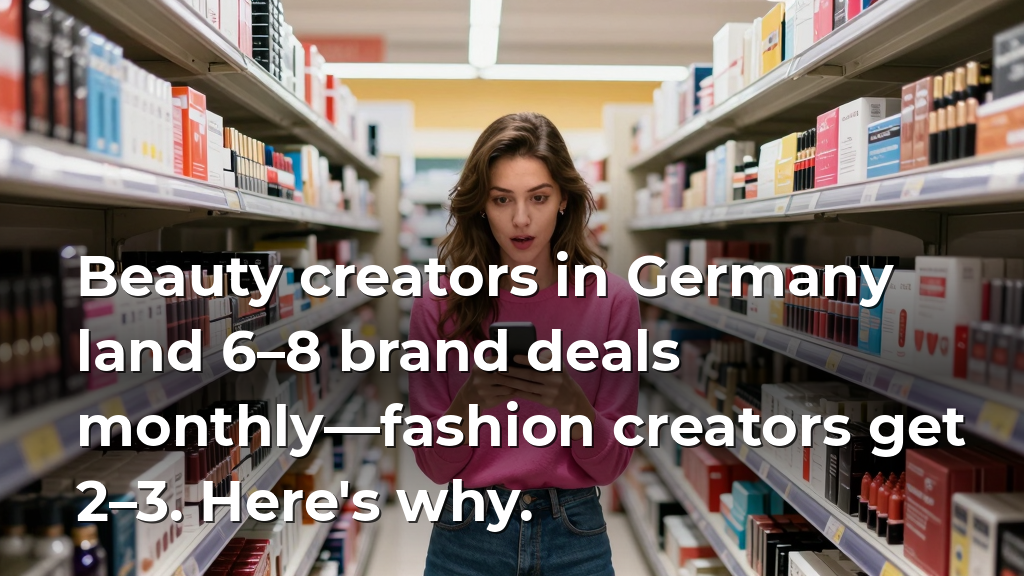
Beauty creators in Germany land 6–8 brand deals monthly—fashion creators get 2–3. Here's why.
15 June 2026
·7 min read
Beauty creators with 50,000 followers are landing 6-8 paid collaborations per month
That's not a typo. While fashion accounts of the same size scrape by on 2-3 deals monthly, beauty creators are working with brands like dm, Rossmann, Sephora, and L'Oréal at nearly triple the frequency. The German cosmetics market—worth roughly €13 billion in end-consumer revenue in 2024—is the engine behind this disparity. And if you're selling outreach or partnership solutions to agencies, consultancies, or brand teams, this is the niche you need to understand.
The numbers come from a recent Virtual Faces analysis of the German creator economy, and they reveal a structural advantage for beauty that isn't going away. Continuous product launches, high engagement rates among micro-influencers, and content that stays relevant for years make beauty the most efficient vertical for brand-deal density per follower.
Let's break down why this matters for your sales strategy—and how you can use it to win more clients.
Why Beauty Creators Outperform Fashion on Deal Frequency
The product launch cycle is the hidden driver
The average beauty brand launches 8-20 new products per year. Compare that to fashion, which typically releases two main collections annually. More products mean more campaigns, more seeding opportunities, and more reasons for brands to keep a steady roster of creators on retainer or in rotation.
This isn't a one-off spike. It's a structural rhythm. A skincare brand like The Ordinary or La Roche-Posay can drop a new serum, a cleanser, and a moisturiser across three different months, each requiring its own creator campaign. A fashion label drops spring/summer and autumn/winter—and that's it. The math is simple: more launches equal more deals.
For sales professionals pitching outreach or partnership platforms, this is your wedge. When a prospect says they're struggling to fill their creator pipeline, ask them how many product launches their beauty clients have planned for the next quarter. If they don't know, you've just identified a gap your solution can fill.
Six sub-niches, six deal streams
Virtual Faces identified six distinct beauty sub-niches in Germany: Makeup Tutorials & GRWM, Skincare Routines, Hair Styling, Nails, Editorial/Avant-Garde, and Sustainable/Clean Beauty. Each sub-niche has its own brand relationships, content formats, and deal structures. A creator can operate in two or three simultaneously, effectively multiplying their collaboration capacity.
Skincare Routines command the highest average Brand-Deal CPM in beauty. Sustainable/Clean Beauty is the fastest-growing sub-niche in Germany, driven by consumer demand for transparency and natural ingredients. Brands like Weleda and i+m Naturkosmetik are actively investing here.
If you're advising a client on where to focus their creator strategy, the recommended starter approach is Makeup Tutorials & GRWM as the main pillar, with Skincare Routines as the second. That combination gives you volume and premium pricing.
Micro-Influencers Are the Real Power Players in German Beauty
Engagement rates that make mega-accounts look lazy
Micro-influencers with 10,000 to 50,000 followers in German beauty achieve engagement rates of 4-6%. Mega-accounts with hundreds of thousands of followers? They average 1.2%, according to the German Influencer Marketing Association. That's a 3-5x difference in audience interaction.
Brands have noticed. They prefer booking ten micro-influencers over one mega-star. The logic is straightforward: ten creators each reaching a highly engaged niche audience generate more authentic conversations, more saves, and more click-throughs than a single broad-reach post that gets scrolled past.
For your sales conversations, this is a powerful reframe. Stop letting prospects fixate on follower count. Show them the engagement data. Ask them whether they'd rather have 1.2% of 500,000 people paying attention or 5% of 30,000 people actively commenting, sharing, and buying. The answer is obvious once you put it that way.
Content that keeps working long after the post goes live
Beauty content has a longer half-life than fashion. A smokey-eye tutorial published two years ago can still generate traffic, comments, and affiliate sales today. Fashion content—a lookbook, a haul video—tends to feel dated after a single season.
This longevity makes beauty creators more valuable as long-term partners. A brand that invests in a tutorial campaign isn't just buying a one-week spike; it's buying an asset that continues to perform. That's a compelling argument when you're trying to convince a client to increase their creator budget or extend a contract.
We covered a similar dynamic in our analysis of live streaming hitting $221B by 2031—the shift toward content that generates ongoing ROI rather than fleeting impressions is reshaping how brands allocate spend.
Three Aesthetic Profiles That Define German Beauty Creator Success
Virtual Faces identified three established aesthetic profiles that resonate with German audiences and brands:
Warm Cottagecore aligns with Clean/Natural Beauty. Think soft lighting, earthy tones, and a focus on ingredients. Brands like Weleda and i+m Naturkosmetik fit naturally here.
Cool Clinical is the Skincare profile. Clean lines, white backgrounds, dermatologist-adjacent credibility. La Roche-Posay and Paula's Choice thrive in this space.
High-Glam Editorial covers decorative cosmetics. Bold looks, dramatic lighting, aspirational styling. Maybelline and Catrice are typical partners.
If you're helping a creator or agency define their positioning, pick one profile and own it. Trying to be all three dilutes the brand signal. Brands know exactly which aesthetic they want, and they filter creators accordingly.
How to Sell Outreach Solutions to Beauty-Focused Agencies and Brands
Start with the data they already trust
When you're pitching a platform like MiraReach to a beauty agency or brand team, lead with the numbers they already know. The €13 billion market size. The 4-6% micro-influencer engagement rates. The 6-8 monthly deals per creator. These aren't hypotheticals—they're the operating reality of the German beauty creator economy.
Then connect the dots: if your prospect's team is manually searching for creators, sending individual emails, and tracking responses in spreadsheets, they're leaving money on the table. Every hour spent on admin is an hour not spent on strategy, relationship building, or closing deals.
We've seen this pattern across multiple verticals. In our piece on TikTok's engagement hitting 3.70% while Instagram flatlined at 0.48%, the same lesson applies: the platforms and niches shift, but the need for efficient, data-driven outreach remains constant.
Use the sub-niche structure to demonstrate precision
Generic outreach fails. Beauty brands don't want a list of 500 random creators. They want 15 creators who are a perfect fit for their specific sub-niche, aesthetic profile, and campaign goals.
Show your prospect how your solution can filter by sub-niche (Skincare Routines vs. Makeup Tutorials), engagement rate threshold (4% minimum), and brand affinity (has worked with competitors or complementary brands). That level of precision is what separates a useful tool from a time-waster.
And don't forget the AI image tools mentioned in the Virtual Faces analysis: Flux for skin-focused content, Nano Banana 2 for visual consistency across posts, and Seedream 4 for editorial looks. If your prospect is creating visual assets for creator briefs, these tools are worth knowing about.
Ready to Turn Beauty Creator Data into Closed Deals?
You now have the numbers, the sub-niche breakdown, and the engagement benchmarks to have smarter conversations with beauty-focused agencies and brands. But data alone doesn't close deals—actionable workflows do. MiraReach helps you automate prospect discovery, email outreach, inbox scoring, and meeting prep so you can spend less time hunting and more time closing.
Whether you're targeting beauty creator agencies, cosmetics brands, or influencer marketing platforms, our AI-powered outreach engine surfaces the right contacts, personalises your messaging at scale, and scores your inbox so you never miss a hot lead. See MiraReach plans and start turning Germany's creator economy data into your next closed-won deal.
Frequently Asked Questions
Why do beauty creators get more paid collaborations than fashion creators?
Beauty brands launch 8-20 new products per year, compared to fashion's two main collections. More products mean more campaigns, seeding opportunities, and ongoing partnerships. The German cosmetics market is also worth approximately €13 billion, providing a large budget pool for creator collaborations.
What engagement rate should I expect from micro-influencers in German beauty?
Micro-influencers with 10,000 to 50,000 followers in German beauty typically achieve 4-6% engagement rates. That's significantly higher than the 1.2% average for mega-accounts, which is why brands prefer booking multiple micro-influencers over a single large creator.
Which beauty sub-niche has the highest brand-deal CPM in Germany?
Skincare Routines have the highest average Brand-Deal CPM among the six beauty sub-niches identified in the German market. Sustainable/Clean Beauty is the fastest-growing sub-niche, driven by consumer demand for natural and transparent products.
What are the three main aesthetic profiles for German beauty creators?
The three established profiles are Warm Cottagecore (Clean/Natural Beauty), Cool Clinical (Skincare), and High-Glam Editorial (decorative cosmetics). Each profile attracts different brand partners and content styles, so creators should pick one and own it rather than trying to cover all three.
Ready to find your next collab partner?
Browse creators, score compatibility, send requests.