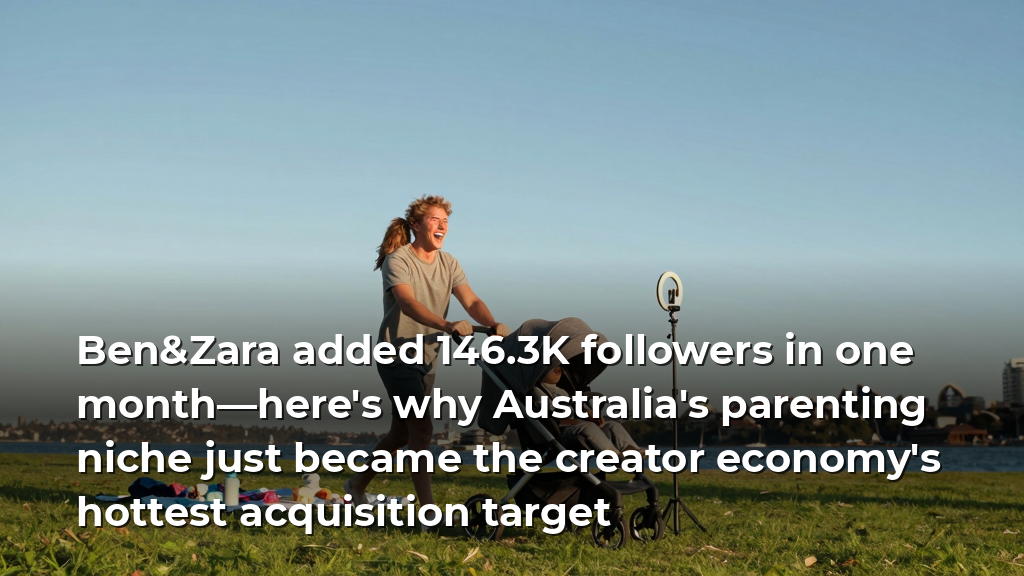
Ben&Zara added 146.3K followers in one month—here's why Australia's parenting niche just became the creator economy's hottest acquisition target
30 August 2026
·7 min read
The Parenting Niche Just Became Australia's Most Underrated Creator Economy Play
Ben&Zara added 146.3K followers in a single month. That's not a typo, and it's not a fluke. According to influData's August 2026 rankings, the Australian Parenting & Family Instagram niche now includes 10,633 active influencers, with the top 20 alone commanding a combined expected reach of 99.8M and 428.4M total followers.
If you're a brand manager, agency strategist, or sales leader looking at creator partnerships, those numbers should stop you mid-scroll. This isn't a niche that's growing—it's a niche that's compounding. And most B2B outreach teams haven't caught up yet.
The average engagement rate across this category sits at 3.51%, which is comfortably above the industry standard. That means the audience isn't just scrolling past—they're stopping, liking, commenting, and sharing. For brands, that's the difference between paying for impressions and paying for influence.
Who's Winning in Australia's Family Influencer Space?
The rankings tell a clear story about what resonates with Australian parents right now. Ben&Zara (@ben.and.zara) leads the pack with 4.8M followers and a 1.67% engagement rate. Their +3.2% monthly growth translated to 146.3K new followers in 30 days—the fastest absolute growth in the category.
But raw follower counts only tell part of the story. Look at the engagement rates more carefully and you'll see where the real opportunity sits.
The Engagement Gap Nobody's Talking About
Heidi Barlow (@womenshealthwithheidi) sits at #2 with 607.3K followers and a 0.06% engagement rate. She grew 18.7% month-over-month (+95.6K followers) and holds the TikTok Educator of the Year 2025 title. But that engagement rate is nearly zero.
Contrast that with Hana | Therapist for Mums (@therapyformums) at #7. She has 229.9K followers—a fraction of Heidi's reach—but her engagement rate is 9.97%. That's 166 times higher than Heidi's. She grew 17.6% last month, adding 34.5K followers.
Here's the uncomfortable truth for brands: follower count is vanity, engagement is sanity, and conversion is reality. If you're picking partners based on reach alone, you're paying for an audience that isn't listening.
What the Demographics Tell Us About the Australian Parent Audience
The audience profile for this niche is remarkably consistent. 75% female, 25% male. The primary age group is 25-34 (44.2%), followed by 18-24 (28.2%). That's a young parent demographic—millennials and older Gen Z—who are actively making purchasing decisions for their households.
Geographically, the audience is concentrated in Australia (37.0%), with significant spillover into the USA (17.1%) and UK (7.5%). Within Australia, Sydney leads at 7.0%, followed by Melbourne (6.6%), Brisbane (4.6%), Gold Coast (2.8%), and Perth (1.6%).
For a sales professional, this is a goldmine of targeting data. If you're selling family products, parenting services, or household goods, you know exactly where to focus your outreach and which creators to approach.
The Mid-Tier Creators Are the Real Opportunity
Here's where it gets interesting. The top-tier creators like Ben&Zara have massive reach but modest engagement. The mid-tier creators—those with 150K-300K followers—are showing engagement rates that dwarf the category average.
Nina (@nina.loves.to.sew) from Melbourne has 155.1K followers with a 1.93% engagement rate and +14.4% monthly growth. Bright Life Project (@bright_life_project) from Perth has 152.2K followers with +13.6% growth. These are creators who are growing fast, engaging their audiences deeply, and likely charging a fraction of what the mega-influencers demand.
This mirrors what we've seen across other creator economies. As we noted in our analysis of which creator tiers are winning the ROI race, mid-tier creators often deliver better cost-per-acquisition because their audiences trust them more deeply.
Why Engagement Rate Matters More Than Follower Count in 2026
Instagram's algorithm has fundamentally changed how content is distributed. The platform now prioritises engagement signals over raw follower counts. A creator with 200K followers and 5% engagement will get more organic reach than a creator with 2M followers and 0.5% engagement.
This is exactly what we flagged when Instagram's AI cut reach for 60% of creators under 10K followers. The platform is rewarding authentic connection over broadcast-style content. For brands, this means the creators who can generate genuine conversation are worth more than those who simply accumulate followers.
The data backs this up. The Humphries Family (@niken.havana_) at #3 has 1.8M followers and a 5.53% engagement rate—the highest among the top 5. They grew 4.2% last month, adding 71.9K followers. That's the sweet spot: significant reach combined with meaningful engagement.
The Zero-Engagement Trap
Some creators in the top 20 show 0.00% engagement rates. Maeva Da Silva (@maeva.aus) has 890.2K followers with zero measurable engagement, despite a 730K TikTok following. Tegan De Vil (@tegan_de_vil) shows 222.1K followers with the same issue.
These creators are growing—Maeva added 31.2K followers and Tegan added 20.8K—but their audiences aren't interacting. This could indicate purchased followers, algorithm manipulation, or content that doesn't inspire action. Either way, it's a red flag for brand partnerships.
If you're doing outreach to creators, this is the data you need before you send a single email. It's the difference between a campaign that converts and one that burns budget.
How Sales Teams Should Use This Data for Creator Outreach
If you're selling products or services to the parenting market, this ranking is your prospecting list. But you need to approach it strategically, not just fire off generic emails to the top 20.
First, segment by engagement rate. The creators with 5%+ engagement are your priority targets. They have audiences that trust them, and that trust transfers to your brand. Second, segment by growth trajectory. A creator growing at 15-20% monthly is building momentum—their audience is expanding, and your brand can ride that wave.
Third, consider the content niche within the category. Hana the therapist for mums serves a different audience than Nina who loves to sew. Your product needs to align with the creator's specific content focus, not just the broad parenting category.
This is where most outreach fails. As we've seen in LinkedIn's B2B lead generation data, 48% of marketers still can't find creator partners who convert. The problem isn't a lack of creators—it's a lack of data-driven selection.
The Personalisation Playbook for Creator Outreach
When you've identified your target creators, your outreach needs to demonstrate that you understand their specific audience and content style. Reference their recent posts. Mention their engagement metrics. Show them you've done your homework.
For example, if you're approaching Hana (@therapyformums), you'd reference her 9.97% engagement rate and her focus on maternal mental health. You'd explain how your product or service complements her content without competing with it. You'd show her the specific value you can bring to her audience.
This level of personalisation requires data. You can't do it with a spreadsheet and a prayer. You need tools that give you real-time insights into creator performance, audience demographics, and engagement patterns.
Ready to Build a Creator Strategy That Actually Converts?
MiraReach helps sales teams and agencies automate prospect discovery, score inbox engagement, and prepare for meetings with data-backed insights. Instead of guessing which creators are worth your outreach budget, you can target the ones with proven engagement and growth trajectories.
Stop wasting time on creators with zero engagement and start building partnerships that deliver measurable ROI. See MiraReach plans and see how data-driven outreach transforms your creator partnerships.
Frequently Asked Questions
Who is the fastest-growing parenting influencer in Australia?
Ben&Zara (@ben.and.zara) is currently the fastest-growing parenting influencer in Australia, adding 146.3K followers in a single month. They lead the influData rankings with 4.8M total followers and a 3.2% monthly growth rate as of August 2026.
What is the average engagement rate for parenting influencers in Australia?
The average engagement rate across Australia's 10,633 parenting and family influencers is 3.51%, which is above the industry average. However, rates vary dramatically by creator, from 0.00% to nearly 10% for top performers like Hana | Therapist for Mums.
Which Australian cities have the most parenting influencer followers?
Sydney leads with 7.0% of the audience, followed by Melbourne at 6.6%, Brisbane at 4.6%, Gold Coast at 2.8%, and Perth at 1.6%. The audience is predominantly Australian (37.0%), with significant followings in the USA (17.1%) and UK (7.5%).
How often is the parenting influencer ranking data updated?
The influData ranking is refreshed weekly, with the latest update including performance data through August 2026. The most recent ranking date is August 13, 2026, so brands can track growth trends and engagement changes in near real-time.
Ready to find your next collab partner?
Browse creators, score compatibility, send requests.