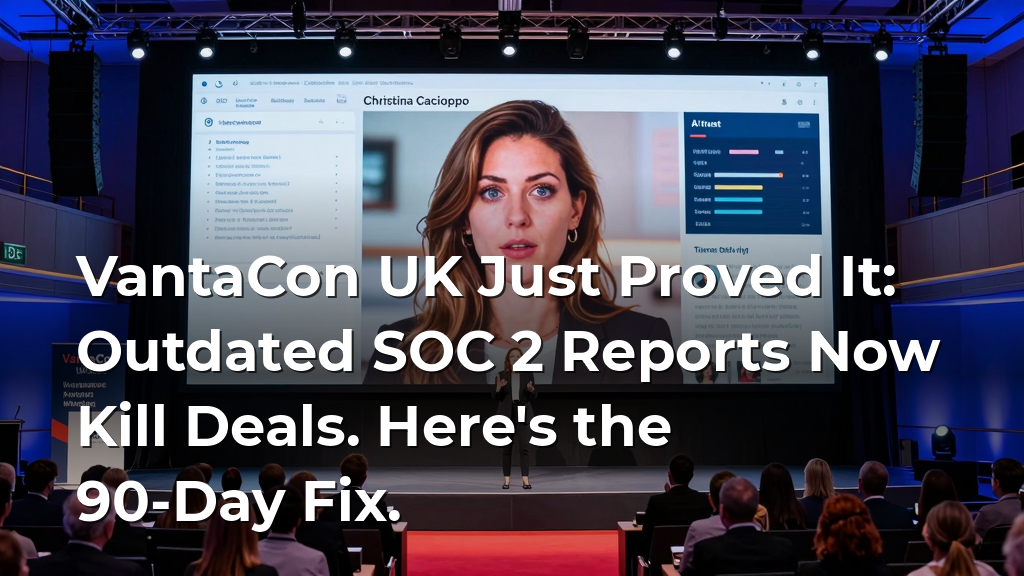
VantaCon UK Just Proved It: Outdated SOC 2 Reports Now Kill Deals. Here's the 90-Day Fix.
13 June 2026
·10 min read
The Compliance Time Sink Is Killing Your Sales Velocity
If you've ever watched a deal stall because the prospect's procurement team demanded a SOC 2 report that's three months out of date, you know the pain. VantaCon UK 2026, held on May 25, 2026, confirmed what many of us have felt: the bar for proving security has been reset. Christina Cacioppo opened with a line that should echo in every boardroom: 'AI is rewriting trust.'
Here's the number that stopped me: 77% of leaders say their stakeholders now demand verified proof of compliance, up 12% year over year. That's not a gentle trend. That's a cliff edge. And the average company spends 12 working weeks a year on compliance work. Twelve weeks. That's a quarter of a year spent proving you're secure instead of actually improving security.
For sales teams, especially those selling into enterprise accounts or regulated industries, this is a direct hit to pipeline velocity. Every extra day spent answering security questionnaires is a day your competitor is closing. But the real friction isn't just the time—it's the process gap between what buyers want and what sellers can deliver. Traditional compliance cycles were built for annual audits, not real-time verification. When a prospect asks for "current" evidence, they mean today, not last quarter. Yet most teams still rely on static PDFs, manual evidence collection, and email chains that stretch for weeks. That gap is where deals die. The 77% figure isn't just a demand for more paperwork; it's a demand for continuous assurance—a shift from periodic snapshots to live, verifiable proof. Without that, your sales cycle doesn't just slow down; it becomes a bottleneck that your competitors can exploit by offering faster, more transparent compliance handoffs. The companies that solve this—by embedding compliance evidence into their sales workflow, not bolting it on after the fact—will turn a time sink into a competitive advantage.
Why Real-Time Compliance Proof Matters for Sales
The Old Way: Screenshots and Hope
Remember the old playbook? You'd pull a PDF from last quarter, cross your fingers that nothing had changed, and send it off. Customers, auditors, and boards now expect real-time, continuous proof. Not a screenshot from last quarter. Live data. Continuous monitoring. If you can't show it, you're out.
Almost two-thirds of leaders say they spend more time proving security than improving it. That's a broken model. And it's costing you deals.
What the Numbers Tell Us
GitHub handled 93% of security questionnaires within six months using Vanta, six months ahead of plan. That's not a vanity metric. That's a sales acceleration tool. When your compliance proof is automated and always current, your sales team stops being a bottleneck and starts being a differentiator.
Vanta announced the Agentic Trust Platform at the event. Jeremy Epling, Chief Product Officer, walked through four product moves that directly address this pain. Vanta Privacy now handles ROPA and DPIA management with agentic workflows for GDPR. They demo'd an agent drafting a DPIA in minutes from existing policy context and processing details. Work that used to take a day now takes minutes.
Risk management now includes multiple risk registers, custom fields per team, and scenario-based scoring that rolls up into a single board-ready enterprise view. Customer Commitments sync contracts from Ironclad today, with DocuSign and Google Drive coming in Q2. Craig Schwartz, General Counsel and Head of InfoSec at Nominal, said: 'Customer Commitments is exactly what teams need to manage obligations with confidence.'
How AI Resets Trust Standards for Sales Outreach
Here's where this gets personal for anyone running sales outreach. If you're using AI to prospect, personalise emails, and score inboxes—like MiraReach does—you need to be able to prove your security posture in real time. Your prospects will ask. Your compliance team will demand it. And if you can't answer instantly, you lose credibility.
Vanta's Trust Graph is the industry's first connected data and intelligence layer for trust and security programs. It runs 400 integrations across cloud infrastructure, security tooling, HR, and identity providers. It runs 1,400+ tests an hour. That's the kind of infrastructure that lets you say 'yes' to a security questionnaire before the prospect finishes typing the question. But the real shift isn't just speed—it's the elimination of the trust gap that has always plagued outbound sales. Traditionally, a prospect's trust relied on static PDFs, annual SOC 2 reports, or manual email assurances that were outdated the moment they were sent. AI resets that standard by making compliance a live, observable process rather than a backward-looking artifact. When your AI outreach tool is wired into a continuous monitoring layer like Vanta's, every personalisation, every data point used in an email, and every inbox-scoring decision is backed by a verifiable chain of controls. This transforms the sales conversation: instead of saying "we passed an audit last quarter," you can say "our data handling controls were verified 14 minutes ago." For regulated industries like finance or healthcare, where a single compliance lapse can kill a deal, this real-time proof isn't a nice-to-have—it's the new baseline for permission to sell.
The Vanta Agent is a 24/7 GRC engineer that knows your frameworks, controls, and systems, with memory built in. Elizabeth Walker, Security Compliance Manager at Samsara, said: 'It is truly like having a 24/7 GRC engineer right on our team.' Samsara's team manages 820 controls across 10 frameworks. If they can do that with automation, your sales team can stop worrying about compliance and start selling.
Real-World Case: Nando's and Minimum Viable Governance
Jason Kirk, CISO at Nando's Group, gave one of the most practical talks at VantaCon UK 2026. Nando's runs roughly 1,200 casual-dining restaurants worldwide, with 14 million active customers and four million UK transactions a month. Between £500 and £600 million flows through its apps annually in the UK alone. More than half of Nando's website traffic is from bad actors.
Jason Kirk runs security across the UK, South Africa, North America, and Australia and New Zealand—with zero direct reports. His operating frame: 'What does minimum viable governance look like?' When Nando's shareholders mandated NIST adoption, he saw no way to hit it without hiring 17 extra people. Until automation.
'When we'd stacked up our requirements, we could see that Vanta was the only tool we could sensibly use,' Kirk said. 'The less pain that I can inflict on my business, the better.' That's the mindset every sales leader needs. Compliance shouldn't be a drag on revenue. It should be a lever.
Kirk's approach cuts through the abstraction that plagues most compliance programs. Minimum viable governance isn't about cutting corners—it's about stripping away every control that doesn't directly reduce risk or satisfy a regulator. For Nando's, that meant mapping NIST's 108 subcategories against actual business processes, not theoretical best practices. The result: a control set that covered the mandate without bloating the security team. This is the practical counterweight to the 77% demand for real-time proof. Real-time doesn't mean real-expensive. Kirk proved that automation can collapse the gap between what auditors want and what engineers can deliver. The lesson for any leader facing a compliance mandate: start by asking which controls actually matter to your revenue cycle, then automate the evidence collection for those and only those. Everything else is overhead.
What This Means for Your Sales Team
If you're selling into enterprise accounts, you need to have this conversation internally. Ask your security team: Can we prove compliance in real time? If the answer is 'we send a PDF,' you have a problem. Your sales cycle is longer than it needs to be. Your win rate is lower than it could be. The gap here isn't technical—it's procedural. Most sales teams still treat compliance as a back-office handoff, not a live sales asset. That model breaks down when procurement teams now expect API-level access to your SOC 2 or ISO 27001 status, not a dated certificate attached to an email. Without that integration, your reps spend deal cycles chasing evidence instead of advancing value conversations.
Christina Cacioppo closed with a line worth remembering: 'Trust isn't a compliance exercise. It's a growth strategy.' That's not a slogan. It's a business model. When your compliance proof is automated, continuous, and verifiable, you stop defending and start selling. The practical shift is this: your sales team needs a dashboard, not a folder. They need to show a prospect that your controls are monitored hourly, not audited annually. That changes the risk calculus for the buyer's legal and procurement teams, who are under pressure to validate vendor posture faster than ever.
For creator economy platforms handling brand partnerships, this is especially critical. Enterprise brand budgets are shifting toward partners who can prove trust infrastructure, not just reach. If you can't show real-time compliance, you're leaving money on the table. The regulatory pressure here is twofold: data privacy laws like GDPR and the UK DPA require demonstrable, ongoing accountability, not a one-time checkbox. Platforms that automate evidence collection—logging access controls, data retention policies, and breach response timelines—turn compliance from a bottleneck into a competitive differentiator. Your sales team should be trained to lead with that infrastructure, not bury it in a data room.
Ready to Turn Compliance Into a Sales Advantage?
MiraReach helps agencies, consultancies, and sales teams automate prospect discovery, email outreach, inbox scoring, and meeting prep. When your outreach is AI-powered, your compliance proof needs to be just as fast. MiraReach integrates with your existing security stack so you can prove trust without slowing down. See MiraReach plans and start turning compliance into a growth strategy.
The shift from compliance as a back-office checkbox to a front-line sales lever is driven by two converging pressures: regulatory scrutiny and buyer skepticism. Under frameworks like the EU AI Act and UK GDPR updates, automated outreach must demonstrate explicit consent, data minimization, and audit trails for every touchpoint. MiraReach addresses this by embedding compliance checks directly into the prospecting workflow—not as a separate review step, but as a native layer within discovery and scoring. For example, when the system scores an inbox, it simultaneously validates that the contact source, consent timestamp, and data retention policy align with your organization's security stack. This eliminates the common bottleneck where sales teams wait days for legal sign-off on a campaign. Instead, compliance proof is generated in real time, attached to each outreach sequence, and can be surfaced during a prospect's due diligence call. The practical outcome: your sales cycle shortens because trust is pre-built into the data, not retroactively claimed. Leaders at VantaCon UK 2026 made clear that buyers now expect this transparency as a baseline—not a differentiator. By integrating compliance into your automation, you convert a regulatory requirement into a repeatable, verifiable advantage that speeds up deal velocity and reduces post-sale audit risk.
Frequently Asked Questions
Real-time compliance proof shifts the burden from periodic, point-in-time attestation to continuous, verifiable assurance. In practice, this means your security controls are under constant surveillance—every configuration change, access log, and data flow is checked against your chosen frameworks (SOC 2, ISO 27001, PCI DSS) as it happens. Regulators and buyers increasingly expect this because a quarterly audit snapshot can miss a breach that occurred the day after the report was signed. For sales teams, this eliminates the "trust us, we passed last quarter" conversation. Instead, you can share a live dashboard or an automated report that shows current posture, not historical compliance. The deeper implication is that compliance becomes a real-time operational metric, not a project with a deadline. This forces process owners to embed controls into daily workflows rather than bolting them on before an audit. For example, if a new cloud resource is spun up, the system must automatically check it against your baseline policies within minutes—or flag it for remediation. That level of rigor reduces the window of exposure from months to hours, which is what the 77% of leaders demanding this are really after: proof that your security is active, not just documented.
Ready to find your next collab partner?
Browse creators, score compatibility, send requests.