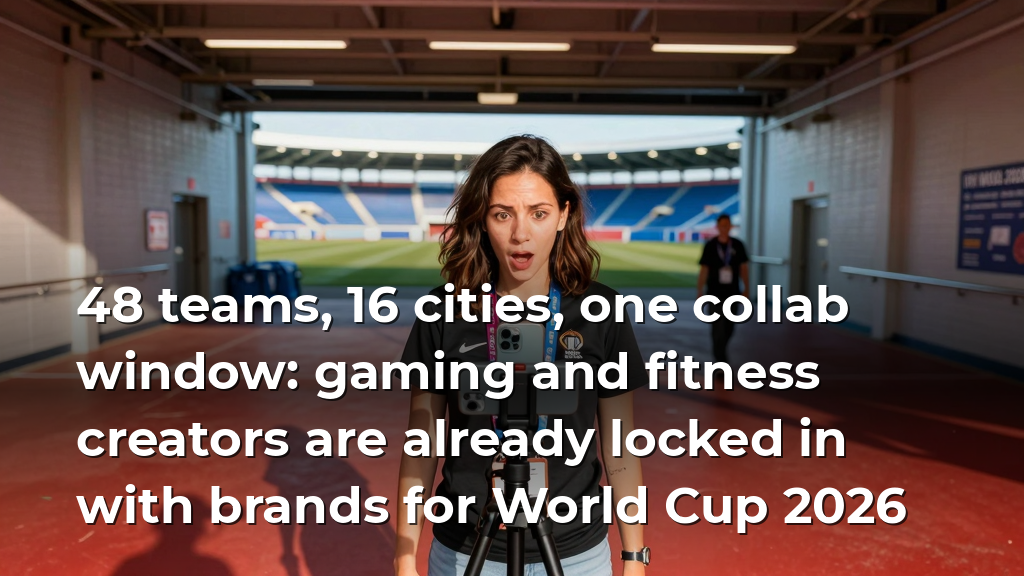
48 teams, 16 cities, one collab window: gaming and fitness creators are already locked in with brands for World Cup 2026
28 May 2026
·7 min read
The 2026 World Cup Is a Collab Goldmine — Here’s What’s Actually Happening
By mid-2026, 48 teams will compete across 16 host cities in the first FIFA World Cup hosted by three countries: the US, Mexico, and Canada. The US alone will host 78 matches, culminating in the final on July 19 in New York/New Jersey. Fox and NBCUniversal are broadcasting. And brands are spending like it’s the Super Bowl times ten.
What’s different this time? Nearly every major activation includes a creator or influencer component. Quaker is running a ticket sweepstakes through June 24, 2026, tied to its Player Escort Program. Visa launched ‘Tap In’ with Jason Sudeikis and five football stars. Lay’s brought in Will Ferrell for ‘Jump on the Bandwagon, America.’ Michelob Ultra paired Messi, Ronaldo Nazário, Alex Morgan, and Billy Bob Thornton in ‘The Superior Match.’
This isn’t a trend — it’s a structural shift. Brands are no longer just buying ad slots. They’re building campaigns around personalities who already have audiences. For agencies, consultancies, and sales teams, that means one thing: the opportunity to broker and execute collabs has never been bigger or more urgent.
Why Creator Collabs Are the New Media Buy
Ten years ago, a World Cup sponsorship meant a logo on a banner and a 30-second spot during halftime. Today, Adidas releases ‘Backyard Legends’ — a film starring Timothée Chalamet, Messi, Bad Bunny, Lamine Yamal, Jude Bellingham, and Trinity Rodman. That’s not an ad. That’s a content ecosystem with six distinct audience segments, each with its own distribution channel.
Dove Men+Care is running ‘Ritual House’ activations in Kansas City, NYC, and Miami — physical spaces designed for content creation and fan engagement. Powerade, the Official Sports Drink, launched ‘Power Your Legacy’ with athlete-led storytelling. Even Valvoline, a motor oil brand, launched its first-ever FIFA World Cup campaign: ‘The Original Motor Oil. For the Driven.’
If Valvoline sees value in a World Cup collab, your prospects should too. The question is: how do you find the right partners and pitch them before someone else does?
The Numbers That Matter
Here’s what the data tells us: Quaker’s sweepstakes runs through June 24, 2026 — that’s a 15-month activation window. Truly Hard Seltzer’s town renaming contest closes April 26, 2026. These are long-lead campaigns. Brands are planning now. If you’re not reaching out to decision-makers today, you’re already late.
Lay’s created a WhatsApp group chat featuring Alexia Putellas, Messi, Beckham, Steve Carell, and Thierry Henry for its ‘No Lay’s, No Game’ campaign. That’s a private, invite-only content play designed for virality. Duracell partnered with Messi for sweepstakes and limited-edition packaging. Celsius launched ‘Electric Vibe’ sparkling beverage with ‘The Surge’ campaign. Budweiser is running a 40-year sponsorship tribute. Coors Light tapped Andrés Cantor for ‘The Coooors Call’ via Droga5. Degree launched ‘Here for Sweat’ with Christian Pulisic.
Every single one of these campaigns required outreach, negotiation, and coordination. That’s where you come in.
How to Identify High-Value Collab Opportunities Before Your Competitors
Most sales teams still rely on manual prospecting — scrolling LinkedIn, guessing email formats, hoping for replies. That worked when the World Cup was a single-country event with 32 teams. Now you’ve got 48 teams, 16 host cities, three countries, and hundreds of brands running parallel activations. Manual outreach won’t scale.
You need a system that surfaces the right contacts at the right time. Start with the brands already spending: Visa, Lay’s, Michelob Ultra, Nescafe, Powerade, Dove Men+Care, Adidas, Duracell, Celsius, Budweiser, Coors Light, Degree, Truly Hard Seltzer, Valvoline. Each has a marketing team, a PR agency, and likely a creator partnerships lead. Find those people.
Then look at the creators and athletes they’re using. Jason Sudeikis, Will Ferrell, Billy Bob Thornton, Timothée Chalamet, Bad Bunny — these are A-listers. But the campaigns also feature Lamine Yamal, Erling Haaland, Christian Pulisic, Alex Morgan, Landon Donovan, Luis García, Alexia Putellas, Jude Bellingham, Trinity Rodman, Weston McKennie. That’s a mix of global superstars and rising talent. The rising talent is easier to reach and more open to new partnerships.
Use Intent Signals, Not Guesswork
When a brand like Truly Hard Seltzer runs a town renaming contest through April 26, that’s a signal: they’re actively investing in fan engagement. When Degree launches a platform with Christian Pulisic, they’re signalling a long-term athlete partnership. These signals tell you who’s spending and where the budget is flowing.
MiraReach’s inbox scoring and prospect discovery tools help you filter for these signals automatically. Instead of manually tracking 20 brand campaigns, you set parameters — host city, sport, activation type — and the platform surfaces the accounts most likely to need your services. Then you sequence outreach based on campaign timelines.
Pitching Collabs That Actually Get Signed
Here’s the hard truth: brands are drowning in pitch emails. Every agency in the world wants a piece of the World Cup. Your pitch needs to stand out by being specific, timely, and low-friction.
Don’t send a generic “we’d love to collaborate” email. Reference the exact campaign they’re running. For example: “I saw your ‘Ritual House’ activation in Kansas City. We represent three local creators with combined followings of 2.4 million who align with Dove Men+Care’s audience. Want to see a one-page proposal by Thursday?”
That works because it shows you’ve done the homework, you’re offering a concrete asset, and you’re respecting their time. No fluff. No “let’s hop on a call to explore synergies.” Just a clear value proposition with a deadline.
Timing Is Everything
Quaker’s sweepstakes runs through June 2026. Truly’s contest closes April 2026. Most campaigns have a 6-12 month lead time. If you’re pitching in May 2026 for a July 2026 activation, you’re too late. Start outreach now. Use the campaign launch dates as your calendar anchors.
For example: Nescafe’s ‘The Nescafe Third Half’ with Landon Donovan and Luis García is a post-match content play. That means they need content creators who can produce quickly after matches. Pitch a roster of creators who specialise in real-time content. Show them how you’ll handle the logistics. Make it easy to say yes.
Measuring Collab Success Beyond Vanity Metrics
Brands care about three things: reach, engagement, and conversion. But the smart ones also care about brand safety, audience alignment, and long-term partnership potential. When you pitch a collab, include a measurement framework upfront.
For example: “We’ll track impressions, saves, shares, and click-through rates. We’ll also monitor sentiment and brand mention volume. Here’s a dashboard template we use for all our campaigns.” That level of professionalism separates you from the 500 other agencies pitching the same brand.
MiraReach’s inbox scoring can also help you prioritise which brand responses to act on first. If a brand opens your email three times in one day, that’s a high-intent signal. Follow up within 24 hours. If they haven’t opened after a week, adjust your subject line or try a different contact.
Ready to Win More World Cup Collabs?
The 2026 FIFA World Cup is a once-in-a-generation opportunity for agencies and sales teams who know how to find the right partners and pitch with precision. But manual prospecting won’t cut it when hundreds of brands are activating across 16 cities and three countries. You need a system that surfaces the best opportunities, scores your inbox for high-intent replies, and automates the repetitive parts of outreach so you can focus on closing deals.
MiraReach helps you do exactly that. Our AI-powered platform handles prospect discovery, email sequencing, inbox scoring, and meeting prep — so you can spend your time on the conversations that matter. See MiraReach plans and start building your World Cup pipeline today.
Frequently Asked Questions
What is a brand collab in the context of the FIFA World Cup?
A brand collab is a partnership between a brand and a creator, athlete, or influencer to promote a product or campaign during the World Cup. Examples include Visa’s ‘Tap In’ with Jason Sudeikis and Adidas’ ‘Backyard Legends’ with Timothée Chalamet and Messi.
How do I find brands running World Cup activations?
Monitor industry publications like Brand Innovators, follow official FIFA sponsors, and track campaign announcements from major brands. Tools like MiraReach can automate prospect discovery by filtering for brands in specific host cities or activation types.
When should I start pitching brands for World Cup collabs?
Start now. Most campaigns have a 6-15 month lead time. Quaker’s sweepstakes runs through June 2026, and Truly Hard Seltzer’s contest closes April 2026. Pitching early gives you time to build relationships and refine proposals.
What metrics should I include in a collab pitch?
Include reach, engagement rate, audience demographics, and brand safety measures. Offer a measurement framework with a dashboard template to show you’re serious about results. Brands appreciate specificity and professionalism.
Ready to find your next collab partner?
Browse creators, score compatibility, send requests.